Modern conference rooms are increasingly adopting advanced display solutions beyond traditional projectors and LCD displays. With growing demands for clearer presentations, remote collaboration, and more engaging communication, LED displays have become an effective visual solution for professional meeting environments.
However, selecting the right LED display requires careful consideration rather than simply choosing a larger screen. Factors such as room size, viewing distance, pixel pitch, brightness, resolution, installation, and connectivity all influence display performance.
This guide explores the key factors for choosing a conference room LED display and helps businesses find the right solution based on their specific needs and project requirements.
Superior Image Quality and Visibility
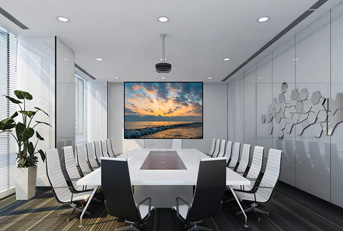
LED displays deliver high brightness, excellent contrast, accurate colors, and sharp image details. Compared with projectors, LED screens maintain clear visibility even in bright meeting rooms without turning off the lights. They are ideal for presentations, data visualization, video conferencing, and product demonstrations.
Seamless Large-Format Display
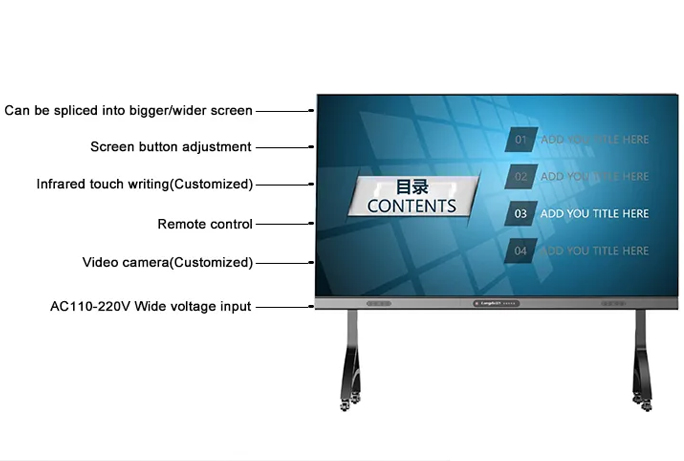
Unlike LCD video walls, LED displays use modular cabinets without visible bezels, creating a seamless viewing experience. They offer flexible sizes and customizable designs for large conference rooms, boardrooms, and training spaces.
Better Collaboration Experience
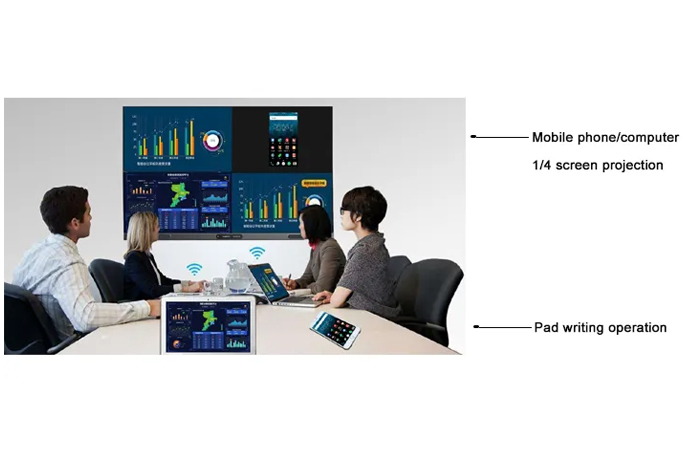
Modern LED displays support wireless sharing, video conferencing systems, interactive functions, and multiple signal inputs, improving team communication, remote collaboration, and meeting efficiency.
Choosing the right display solution is essential for creating an efficient meeting environment. Compared with projectors and LCD video walls, LED displays offer better visibility, flexibility, and long-term performance.
2.1 LED Display vs Projector
|
Feature |
LED Display |
Projector |
|
Brightness |
High |
Affected by ambient light |
|
Image quality |
Clear and stable |
May lose clarity |
|
Maintenance |
Low |
Requires lamp replacement |
|
Installation |
Flexible |
Requires projection distance |
LED displays provide more reliable performance for professional conference rooms.
|
Feature |
LED Display |
LCD Video Wall |
|
Seam |
Seamless |
Visible bezel |
|
Size customization |
High |
Limited |
|
Viewing angle |
Wide |
Depends on panel |
|
Large spaces |
Excellent |
Moderate |
For immersive large conference rooms, LED displays are often the preferred choice.
The ideal Led screen size depends on conference room dimensions, participant numbers, and viewing distance. Small meeting rooms usually require 100-150 inch displays, medium rooms 150-200 inch displays, and large conference halls 200 inch or above. The screen should allow all participants to read content clearly without visual strain.
Pixel pitch refers to the distance between LED pixels. Smaller pixel pitch provides higher resolution and better close-range viewing. P0.7-P1.2 is suitable for premium boardrooms, P1.2-P1.8 for corporate conference rooms, and P1.8-P2.5 for medium meeting spaces. Closer viewing distances require smaller pixel pitch.
Resolution directly affects the clarity of text, charts, videos, and detailed graphics. Full HD is suitable for basic presentations, while 4K is recommended for large rooms and detailed content. 8K is ideal for premium applications where maximum image quality is required.
Conference rooms with windows and artificial lighting require balanced brightness and contrast. Indoor conference LED displays typically use 600-1200 nits to ensure clear images without causing discomfort.
A wide viewing angle, usually ≥160°, ensures participants can enjoy consistent image quality from different seating positions.
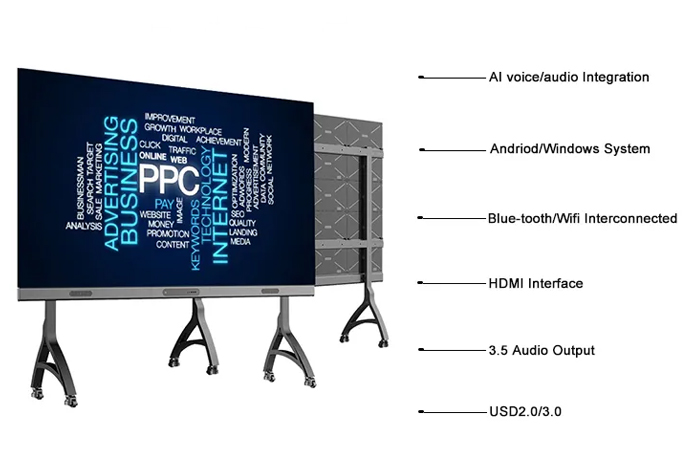
Consider installation methods, cable management, maintenance access, and compatibility with HDMI, USB, wireless casting, video conferencing, and control systems for efficient operation.
The ideal LED display solution depends on the room size, audience capacity, and viewing distance. Selecting the right pixel pitch and screen configuration ensures clear visibility and better meeting experiences.
|
Conference Room Type |
Features |
Recommended Solution |
Applications |
|
Small Meeting Rooms |
Less than 10 people, short viewing distance |
Fine pixel pitch LED, P0.9-P1.8 |
Team meetings, small presentations |
|
Medium Conference Rooms |
10-50 participants |
P1.2-P2.5 LED display |
Corporate meetings, training sessions |
|
Large Conference Halls |
Large audiences, long viewing distance |
Large LED video walls |
Conferences, auditoriums, corporate events |
Choosing a suitable LED display helps businesses maximize visual performance and communication efficiency.
When selecting an LED display for a conference room, avoiding common mistakes can improve performance and reduce unnecessary costs.
Mistake 1: Choosing Screen Size Only Based on Budget
A low-cost but undersized screen may reduce visibility and affect meeting efficiency.
Mistake 2: Ignoring Viewing Distance
Incorrect pixel pitch selection can cause blurry images and a poor viewing experience.
Mistake 3: Selecting Excessive Brightness
Overly bright screens may create viewing discomfort.
Mistake 4: Ignoring Maintenance Requirements
Consider front maintenance, spare parts availability, and technical support for long-term operation.
Proper maintenance helps extend the LED display lifespan and improves long-term return on investment. Regularly clean the screen surface, check connections, monitor brightness levels, update control systems, and arrange professional inspections when needed. These practices help maintain stable performance, reduce potential failures, and ensure consistent image quality throughout daily conference room operations.
Choosing an LED display for conference rooms requires careful consideration of screen size, pixel pitch, resolution, brightness, viewing distance, and installation requirements. The right combination of these factors ensures clear visuals, comfortable viewing, and better meeting performance.
A suitable LED display can improve communication efficiency, presentation quality, and collaboration experiences. As a custom LED display manufacturer, HongweiLED provides professional LED solutions tailored to different conference room applications. From design and manufacturing to installation support, HongweiLED helps businesses create reliable and high-performance visual environments. Contact HongweiLED today to discuss your conference room LED display project.
By continuing to use the site you agree to our privacy policy Terms and Conditions.